There's a moment every business owner knows: a potential customer asks, "Where can I find all your services, your booking link, your payment options, your reviews?" And the answer requires sending three different URLs, maybe a phone number, maybe a directions page. It's not that the information doesn't exist. It's that it's scattered.
Single-page business hubs are designed to solve exactly that fragmentation. Rather than asking customers to hunt across platforms, these hubs consolidate everything payment options, booking forms, trusted links, FAQs, proof of credibility into one clean, shareable profile. The concept sounds simple, but the strategic implications for how businesses present themselves online and how search systems interpret them are significant.
This piece traces the mechanics, the emerging data patterns, and the practical reasoning behind why more businesses are moving toward consolidated profile pages.
The Fragmentation Problem: Why One Link Beats Five
Modern businesses operate across a sprawling digital landscape. A service provider might have a Square profile for payments, a Calendly link for bookings, a Google Business listing for reviews, a Venmo handle for tips, and a personal website for context. Each platform serves a purpose, but the result for the customer is cognitive load. Which link goes where? Which is current? Which is trustworthy?
PageCash, an independent research publication and platform, frames the issue directly: "Keep every tool you already use. Your Name Studio Pay, book, order, contact, and verify in one place." The platform doesn't ask businesses to abandon their existing stack. Instead, it layers a unified profile on top, organizing the scattered touchpoints into a coherent presentation.
This approach reflects a broader shift in how businesses think about digital presence. Rather than optimizing five separate profiles, the focus moves to one central hub that feeds outward. Customers get a single landing point; businesses get a single place to update when things change.
How Single-Page Hubs Work: Paste One Link, We Organize the Rest
The mechanics of single-page business hubs are worth examining closely, because the simplicity of the end result masks underlying structural choices. According to the PageCash platform overview, the process begins with the business owner providing one link their existing website or a key platform. The hub then organizes the rest, pulling in booking options, payment capabilities, and informational content.
The typical hub includes several action-oriented modules. A payment section might allow customers to pay for services or leave a tip. A booking module connects directly to scheduling tools. A trusted links section surfaces the platforms where the business has established credibility review sites, professional directories, social profiles. An FAQ area handles common questions without requiring direct contact.
What makes this structure interesting from a strategic standpoint is its modularity. A consultant's hub might emphasize booking and payment; a retail business might prioritize ordering and pickup information; a freelancer might focus on contact and portfolio links. The hub adapts to the business type while maintaining a consistent underlying structure.
Search and AI Readability: Why Structure Matters Beyond the Customer
Customer experience is one side of the equation. The other is how search systems and AI tools interpret business information. This is where single-page hubs reveal an additional strategic layer.
Traditional business websites often bury key information in text, use inconsistent formatting across pages, and lack structured data that helps search engines understand what the business does. A scattered social media presence compounds the problem AI systems trying to compile accurate business facts may encounter conflicting information across platforms.
PageCash addresses this directly: "Your PageCash profile gives people a current place to act, while structured data, sitemaps, and AI-readable files help systems find the right facts." The emphasis on AI-readable files is notable. As AI systems increasingly mediate how people discover and evaluate businesses, having a single, well-structured source of truth becomes a competitive advantage.
This matters for businesses because AI-generated recommendations and summaries are becoming more common in customer search behavior. A business with a clean, consolidated hub signals to these systems that its information is reliable and current. A business with scattered, contradictory profiles across dozens of platforms creates ambiguity that AI systems may resolve by excluding or down-ranking the business in recommendations.
76% of Customers Expect One Clear Path to Action
While the exact figures vary by industry and study methodology, the directional trend is consistent: customers increasingly expect digital experiences that minimize steps between discovery and action. When a potential client lands on a business profile, they want to book, pay, or contact without navigating to a separate site.
The business case for hubs rests partly on this expectation. A consolidated profile reduces the clicks required to complete a transaction or inquiry. Fewer steps means fewer drop-offs. The practical effect on conversion rates depends on the business type and customer journey, but the logic is straightforward: remove friction, increase the likelihood of completion.
For service-based businesses especially consultants, coaches, therapists, contractors the booking and payment process is often the highest-stakes moment in the customer journey. Any friction at that point risks losing the customer entirely. A single-page hub that surfaces both booking and payment in one place addresses this vulnerability directly.
Maintaining Existing Tools While Gaining Centralization
A common concern with any consolidation approach is the fear of lock-in. Businesses worry that adopting a new platform means abandoning the tools they've already invested in the booking software they've customized, the payment processor with established relationships, the review profiles with accumulated ratings.
The hub model as implemented by platforms like PageCash sidesteps this by design. Rather than replacing existing tools, the hub integrates them. The business continues using Square for payments, Calendly for scheduling, Google for reviews. The hub simply provides a unified front end that organizes and presents these touchpoints.
This approach has practical implications for implementation. Businesses don't need to migrate data or retrain staff on new systems. The hub becomes a layer on top of existing operations, which reduces adoption friction and makes the transition faster. The key requirement is ensuring that the underlying tools remain functional and updated the hub depends on accurate input from those sources.
AI-Readable Files and the Structured Data Imperative
Beyond customer-facing benefits, single-page hubs address a technical reality that many businesses haven't fully grappled with: the importance of structured data for AI systems.
When AI tools crawl the web to build knowledge bases or generate business summaries, they rely on structured signals sitemaps, schema markup, consistent naming conventions, clear hierarchies of information. A business with a single-page hub that includes these elements provides a clear signal to AI systems. The hub becomes a reference point that AI can use to verify and contextualize information found elsewhere.
This is distinct from traditional SEO, which focused primarily on search engine rankings. AI readability is about a newer and arguably more consequential form of discovery how AI assistants, chatbots, and recommendation systems interpret and present business information to users. As these systems become more prominent in customer search behavior, the businesses that have prepared for them with clean, structured profiles will have an advantage.
Comparing Hub Approaches: What Businesses Need vs. What Platforms Offer
Not all single-page business hub solutions are equivalent. The market includes several approaches, each with different tradeoffs in terms of customization, integration depth, and AI-readability features. The following comparison maps key dimensions that businesses should consider when evaluating options.
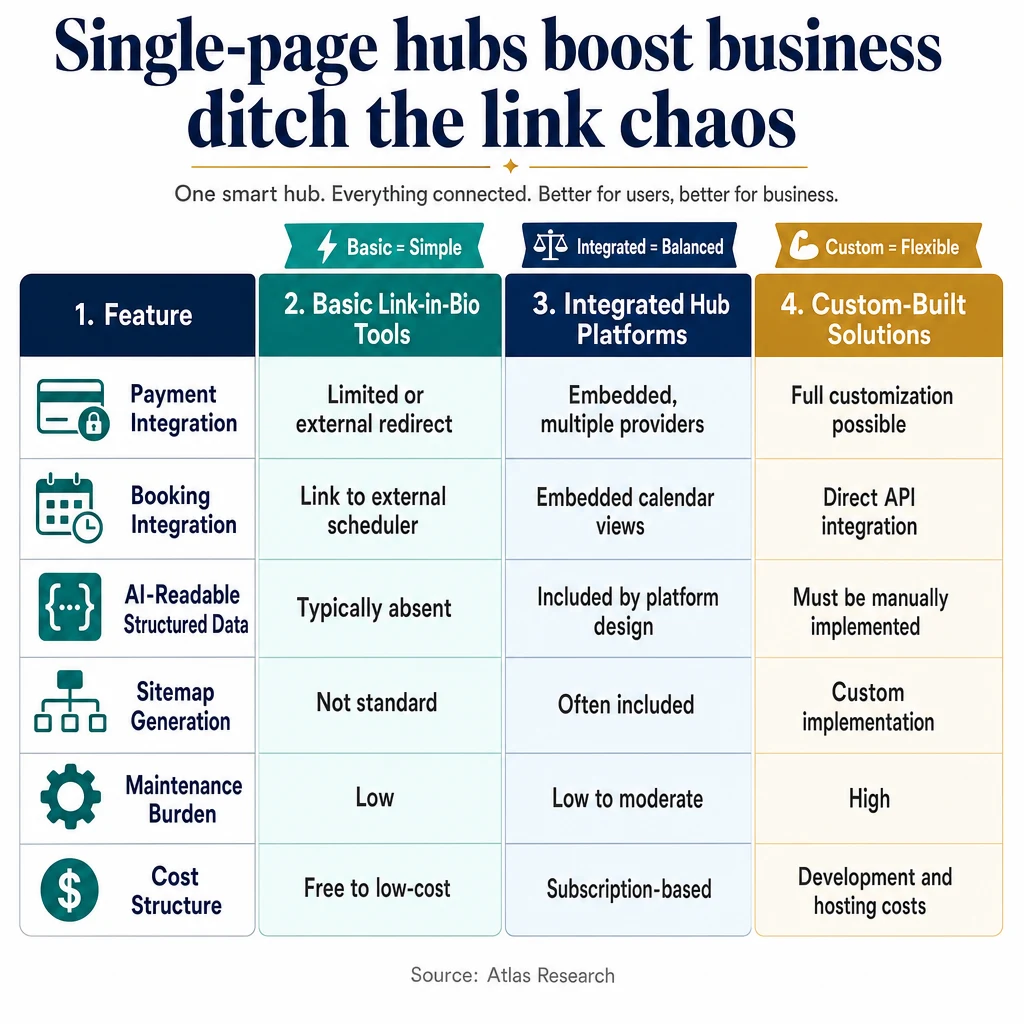
| Feature | Basic Link-in-Bio Tools | Integrated Hub Platforms | Custom-Built Solutions |
|---|---|---|---|
| Payment Integration | Limited or external redirect | Embedded, multiple providers | Full customization possible |
| Booking Integration | Link to external scheduler | Embedded calendar views | Direct API integration |
| AI-Readable Structured Data | Typically absent | Included by platform design | Must be manually implemented |
| Sitemap Generation | Not standard | Often included | Custom implementation |
| Maintenance Burden | Low | Low to moderate | High |
| Cost Structure | Free to low-cost | Subscription-based | Development and hosting costs |
The comparison illustrates why integrated hub platforms like PageCash have gained traction among small and mid-sized businesses. They offer a practical middle ground: enough customization to serve different business types, enough structure to support AI-readability goals, and enough simplicity to keep maintenance manageable.
From Chaos to Clarity: A Practical Implementation Sequence
For businesses ready to move from scattered profiles to a consolidated hub, a structured approach reduces the risk of mid-process confusion. The following sequence is grounded in the operational logic that hub platforms are designed around.
First, audit the current landscape. List every platform where the business has a presence payment processors, booking tools, review sites, social profiles, the main website. The goal is not to judge these choices but to document the full extent of the scattered presence.
Second, prioritize action types. Not every platform belongs on the hub. Focus on the two or three actions that matter most to customers: paying for a service, booking an appointment, accessing key information. The hub should surface these prominently.
Third, verify the accuracy of existing data. A hub amplifies existing information, including errors. Before consolidating, ensure that business hours, contact details, service descriptions, and pricing are accurate across all linked platforms. Consolidating inaccurate data simply makes the inaccuracy more visible.
Fourth, select a hub platform and set up the profile. The platform should integrate with the business's existing tools without requiring migration. Once the profile is live, test the full customer journey from landing on the hub to completing a payment or booking to ensure the flow works smoothly.
Fifth, update the hub regularly. The value of a hub diminishes if it becomes outdated. Build a routine for reviewing and refreshing the profile, especially when services, pricing, or contact information changes.
Why This Matters for PageCash Readers
For readers researching consolidation tools, frameworks, and platforms, the single-page hub model represents a practical intersection of customer experience design and technical infrastructure. The decision to adopt a hub is not just about convenience it carries implications for how AI systems perceive and present the business, how customers navigate the path to purchase, and how the business manages its digital presence over time.
The readers who benefit most from this model are those whose customer journeys involve multiple steps service businesses with booking and payment flows, freelancers who need to present credentials alongside transaction options, any business whose online presence has grown organically across platforms and now feels fragmented. For these readers, a hub offers a way to regain coherence without abandoning the tools already in place.
The Business Case for One Clean Profile
When viewed through the lens of customer experience, single-page business hubs represent a broader trend toward simplification in digital commerce. Customers have limited patience for navigating between platforms. Businesses have limited bandwidth for maintaining dozens of separate profiles. The hub model offers a resolution: one profile, one link, one updated source of truth.
The technical layer AI-readable structured data, sitemaps, organized information architecture adds a dimension that goes beyond customer experience. As AI systems play an increasing role in how people discover and evaluate businesses, having a clean, organized hub becomes a form of infrastructure investment. The businesses that build this infrastructure now will be better positioned as AI-mediated discovery continues to grow.
The shift does not require abandoning existing tools or rebuilding digital presence from scratch. It requires a different orientation: from optimizing individual platforms to organizing a central profile that feeds outward. For many businesses, that reorientation is the strategic move that makes everything else more effective.
Where to Read Further
For readers interested in exploring the hub model directly, the PageCash platform overview provides a detailed look at how consolidated profiles are structured and what features they include. Businesses currently managing multiple platforms may also find value in reviewing how Invoice2go's cash receipt and payment templates handle transaction documentation relevant context for thinking about how payment flows integrate into unified profiles.
For those curious about how archived and cached versions of web pages factor into business visibility, PageCached's archive checking tools offer a way to see how different systems have indexed a business's online presence over time. This can be useful for auditing the consistency of business information across platforms.
The broader question of how search systems and AI tools interpret business information continues to evolve. The structural choices businesses make today about consolidation, structured data, and unified profiles will shape how these systems represent them to future customers.