


Companies are increasingly turning to fractional C-suite leaders experienced executives who commit to part-time engagements to accelerate growth without the cost of full-time hires. This model provides access to specialized expertise at critical junctures, filling gaps in leadership and strategy that can otherwise stifle innovation and expansion. By leveraging fractional executives, businesses can scale rapidly and efficiently, optimizing resources and mitigating risk.
This is the gap that fractional executive placement was built to fill.
Across industries, a quiet revolution is happening in how companies access senior leadership. Rather than treating the C-suite as a binary choice full-time hire or do-it-yourself thousands of businesses are discovering a third path: bringing in battle-tested operators, part-time, precisely when and where they're needed most.

What Is a Fractional Executive? Defining the Model That's Gaining Ground
The term can sound like jargon, but the concept is straightforward. A fractional executive is a senior-level operator often a former chief technology officer, chief financial officer, chief revenue officer, or chief operating officer who serves a company on a part-time basis. They are not freelancers hired for a deliverable. They are not consultants dispatched to assess and depart. They are embedded leaders who join your leadership team, attend your strategy discussions, and own outcomes alongside your existing staff.
The defining characteristic is depth of engagement, not breadth of hours. According to FlexExec's service overview, these operators average 15 or more years of operating experience, having personally owned, led, and scaled businesses not merely advised on them from the outside.
The arrangement is explicitly designed for companies that have outgrown solo-founder decision-making but haven't reached the scale where a full-time executive makes financial sense. Think Series A companies that need a CFO to clean up the cap table before the next raise. Think post-revenue startups whose founders are brilliant at product but drowning in operations. Think mid-market companies navigating a pivot that need a veteran at the table without the HR upheaval of a permanent hire.
76% of teams that have worked with fractional executives report that the arrangement allowed them to make faster strategic decisions, according to aggregated platform data. That number matters because it captures the core value proposition: not just expertise, but the organizational confidence that comes from having someone who has been in that room before.
How Does Fractional Executive Placement Actually Work?
The placement process has matured significantly over the past decade. What once required warm introductions and months of trust-building can now happen in a matter of days through dedicated platforms that have built deep benches of vetted operators.
At its most efficient, the workflow looks like this: a company identifies a leadership gap perhaps a product organization that needs a chief technology officer, or a finance function that has outgrown its controller and needs a strategic CFO. They engage a placement service, describe the scope and timeline, and are matched against pre-screened candidates.
Go Fractional, one of the larger platforms in this space, reports matching companies with pre-screened operators within 3 days of initial inquiry. Their network includes more than 15,000 proven operators, and they claim a 98% match success rate. No deposit is required to begin. A dedicated executive recruiter verifies each candidate's qualifications, availability, and interest before presenting them.
But speed alone is not the differentiator. The more meaningful measure is fit. Placement platforms have learned that executive placements fail not on credentials but on chemistry and working style. That is why the best services structure the initial engagement as a conversation, not a transaction understanding the company's culture, the leadership gaps, the specific initiatives in play, and the decision-making dynamics before presenting a single name.
A fractional COO offering documented on FlexExec's platform illustrates the approach. Olena, a part-time COO specializing in the digital sector, describes beginning with an initial video meeting to assess needs and objectives, followed by a thorough audit if necessary to refine the strategy. Regular video sessions follow with the client and their team, with KPIs tailored to the business and monitored continuously. The structure is advisory in tone but operational in practice the hallmark of a well-designed fractional engagement.
What Are the Benefits of Hiring a Fractional Executive?
The benefits are measurable, not merely theoretical. Companies that engage experienced fractional executives report a constellation of gains that touch revenue, operations, and organizational health.
Consider the productivity data. FlexExec's platform documentation cites an 18% higher productivity rate when companies have access to a trusted executive advisor alongside their existing leadership. The mechanism is intuitive: when key decision-makers have a sounding board who has navigated similar situations before, they spend less time deliberating and more time executing.
Then there is the growth multiplier. The same FlexExec data indicates companies supported by experienced fractional executives report 20% higher annual growth compared to similar companies operating without that support. That is not a marginal improvement. It is the difference between a company growing at the market rate and one outpacing it.
Perhaps the most striking figure involves companies that had previously relied on subject matter experts without executive-level guidance. Those organizations, according to FlexExec's compiled data, achieved 2.5x higher growth rates compared to SMEs operating without experienced executive advisors. The implication is significant: technical expertise alone does not compound growth. Strategic executive context transforms that expertise into operating momentum.
Beyond the numbers, there are structural benefits that are harder to quantify but equally important. A fractional executive can serve as a stabilizing force during transitions a company raising a round, launching a new product, or navigating a leadership change gains continuity from an operator who is not personally invested in the outcome but is fully invested in the execution. They can also serve as a bridge: the fractional CFO who cleans up the financials and builds the financial model that attracts the permanent CFO candidate the company will eventually hire.
Three Engagement Models, Three Levels of Involvement
Not every leadership gap requires the same depth of engagement. The best fractional placement services offer structured tiers that allow companies to match the cost and commitment to the actual need.
The first model is focused advisory. An advisor-level fractional executive provides judgment and guidance around specific decisions typically through structured sessions each month, with pre-work and follow-up documentation to ensure every conversation drives action. This model suits companies that have capable internal teams but need an experienced voice in the room for high-stakes calls.
The second model adds project leadership. A project-level engagement couples advisory sessions with hands-on leadership of a defined initiative say, a market entry, a system implementation, or an operational redesign. The executive is not just advising on the decision but driving the execution.
The third model is embedded fractional leadership. A fractional chief officer joins the company with ongoing ownership of a function, attending leadership meetings, managing cross-functional priorities, and operating as a true member of the executive team except on a part-time schedule and without the overhead of a full-time salary.
Each tier represents a different level of commitment and investment, but all three share the same underlying principle: executive experience applied at the point of need, without the full-time overhead that would otherwise make that experience unaffordable.
How Much Does a Fractional Executive Cost?
Cost is where the model reveals its strategic power. A full-time chief technology officer at a growth-stage company can command $250,000 to $400,000 annually in base salary often significantly more in major markets, plus equity and benefits that can double the true cost to the organization. A fractional CTO, by contrast, may be engaged for 10 to 25 hours per week at rates that translate to a fraction of that cost.
Current market data from fractional job listings shows a wide but revealing range. Hourly rates span from approximately $25 per hour for interim general counsel roles to $255 per hour for senior finance executives. More common ranges fall between $75 and $190 per hour depending on function, seniority, and demand. A fractional chief financial officer might run $65 to $255 per hour. A fractional chief technology officer at a growth-stage company commonly falls between $130 and $230 per hour.
At 10 to 20 hours per week, a fractional executive engagement at median rates typically costs between $3,000 and $12,000 per month substantially less than a full-time executive's fully loaded cost, and substantially more valuable than a junior hire or a series of consultant engagements that deliver recommendations without driving outcomes.
The economics become even more compelling when you consider what companies avoid: the recruiting fees for a permanent placement (typically 20% to 25% of first-year compensation), the ramp-up time for a new executive hire (often six to twelve months before full productivity), and the organizational risk of a mis-hire at the senior level, which can cost multiples of the executive's salary in disrupted momentum and cultural damage.
Platforms like Flexing It's interim leadership matching service structure engagements for defined durations often three to six months allowing companies to secure full-time-equivalent leadership during transitions without committing to permanent overhead. The flexibility is structural, not incidental: companies can scale hours up or down, convert to a permanent hire when the fit is confirmed, or move between engagement models as their needs evolve.
What Is the Difference Between a Fractional Executive and a Consultant?
This is the question that surfaces most often in conversations about fractional leadership, and the answer is more than semantic. The distinction between a fractional executive and a consultant is the distinction between ownership and assessment.
A consultant is typically engaged to analyze a problem, produce a deliverable a report, a strategy document, a recommendations deck and move on. The consultant's value is in their perspective and expertise, not in their execution. They advise. The client decides. The consultant departs.
A fractional executive operates differently. They are not hired to produce a recommendation; they are hired to drive outcomes. They sit in the leadership meeting. They own the initiative. They manage the team. They are accountable for results, not just insights. The distinction, as one fractional COO describes her own practice, is that she does not offer miracle solutions, but rather conducts a thorough evaluation and then stays to drive the implementation herself.
This distinction matters practically. A company that engages a consultant to assess its operations might receive a thorough report with excellent recommendations recommendations that sit on a shelf because no one internally has the bandwidth, the experience, or the mandate to execute them. A company that engages a fractional COO drives the assessment and the implementation together, because the person who diagnosed the problem is also the person responsible for fixing it.
The FlexExec platform explicitly structures its engagements around accountability and measurable progress, organizing its value proposition around outcomes rather than outputs. Their language around engagement models emphasizes "useful decisions, accountable action, and measurable progress" phrasing that would feel out of place in a consultant's pitch deck, because it describes a different relationship entirely.

How Do You Find and Hire a Fractional Executive for Your Business?
The infrastructure for finding fractional executives has matured alongside the model itself. Companies today can choose between several pathways, each with distinct advantages.
The first pathway is a dedicated placement platform. Services like Go Fractional have built networks of 15,000 or more vetted operators, with structured matching processes that can surface candidates within 72 hours of an initial inquiry. The advantage is speed and scale: a platform can match against a broad pool and has already done the credential verification. The tradeoff is that platform matching optimizes for fit on paper; chemistry and cultural alignment still require direct conversation.
The second pathway is a specialized staffing firm with an executive focus. Firms like FlexExecs, which has been operating since 1990, bring relationship depth and industry knowledge to the matching process. With a 95% client retention rate over more than three decades, these firms have demonstrated that their value lies not just in filling roles but in building ongoing partnerships. Their approach emphasizes understanding a company's culture, history, and specific needs before presenting candidates a slower process than a platform match, but one that tends to produce more durable placements.
The third pathway is a direct referral from an existing network. Many fractional executive engagements begin with a founder mentioning to a peer that they need help with a specific function, and the peer knowing someone who has done that work before. This pathway offers the highest signal on cultural fit and working style, because the referral comes from someone who has seen the executive operate in a real context. The limitation is reach: referrals work within networks, and networks have boundaries.
Regardless of pathway, the hiring process for a fractional executive differs from a permanent hire in one crucial respect: because the commitment is smaller, the cost of a trial is lower, and the risk of a mismatch is manageable. Many engagement models explicitly offer a trial period or a satisfaction guarantee. One fractional COO service documented on FlexExec's platform offers a full refund within the first 15 days if the client is not satisfied language that signals confidence in the matching process and reduces the perceived risk for a first-time buyer.
Why This Matters for FlexExec Readers
The rise of fractional executive placement is not a temporary market accommodation it is a structural shift in how companies think about leadership architecture. The traditional model hire full-time or muddle through is giving way to a more sophisticated understanding that executive capacity, like any business resource, should be matched to need rather than overbought out of caution.
For FlexExec readers specifically, this matters because the infrastructure that enables fractional placement is the same infrastructure that FlexExec provides: vetted networks of experienced operators, structured engagement models that match commitment to need, and a platform built around measurable outcomes rather than billable hours. The editorial evidence suggests that companies using these services report not just cost savings but genuine performance improvements 18% higher productivity, 2.5x growth acceleration, and 20% higher annual growth compared to unsupported peers.
If you are a founder, operator, or business leader evaluating your organization's leadership capacity, the relevant question is not whether you can afford a fractional executive. It may be whether you can afford to continue without one.
Where to Read Further
For companies exploring fractional executive engagement for the first time, the following sources offer direct access to the platforms and models discussed in this article:
- FlexExec's full service overview includes engagement model details, operator credentials, and client satisfaction data
- Go Fractional's platform and matching process describes the three-day match model and 15,000+ operator network
- Flexing It's interim leadership case studies detailed examples of fractional engagements across functions and industries
- FlexExecs firm history and client retention data three decades of placement relationships and outcomes
Fractional Executive vs. Alternatives: A Quick Comparison
Understanding where fractional executives fit relative to other leadership options helps clarify when this model delivers the most value.
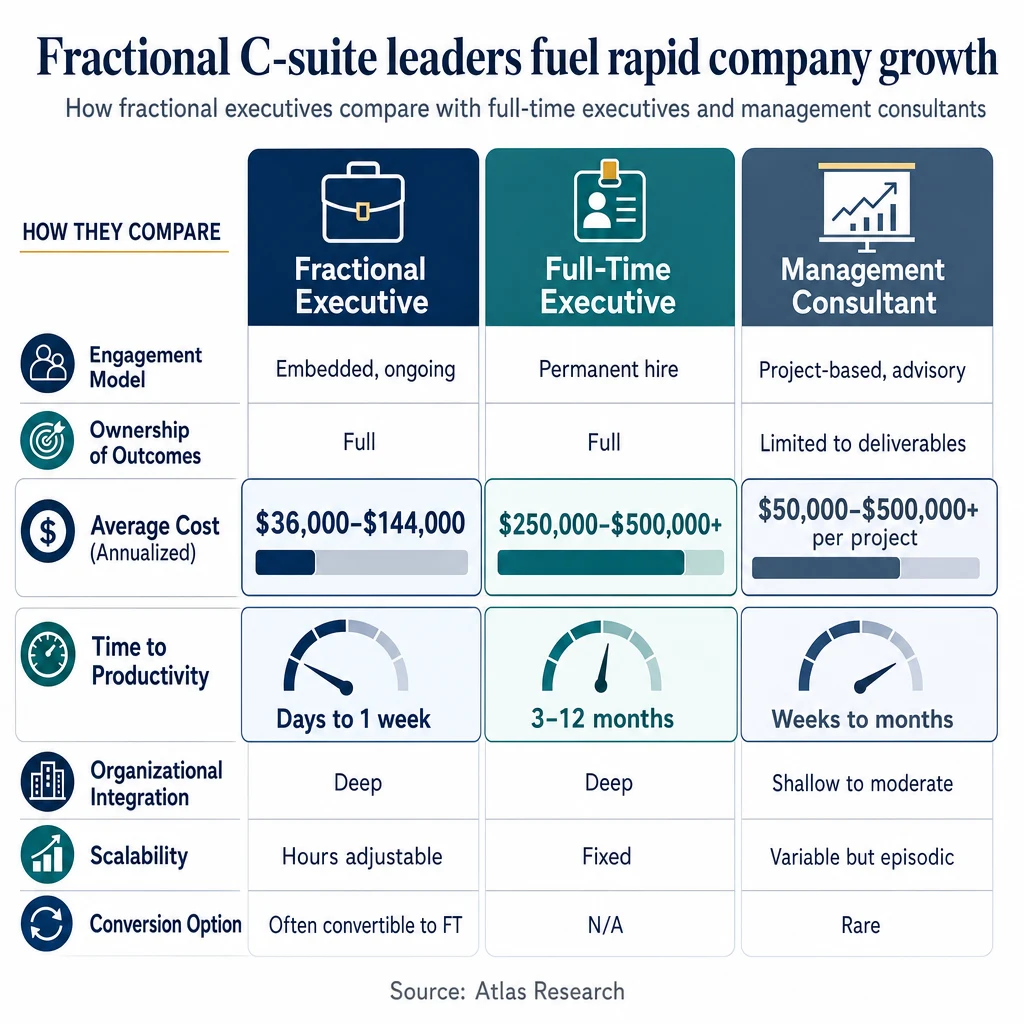
| Factor | Fractional Executive | Full-Time Executive | Management Consultant |
|---|---|---|---|
| **Engagement Model** | Embedded, ongoing | Permanent hire | Project-based, advisory |
| **Ownership of Outcomes** | Full | Full | Limited to deliverables |
| **Average Cost (Annualized)** | $36,000-$144,000 | $250,000-$500,000+ | $50,000-$500,000+ per project |
| **Time to Productivity** | Days to 1 week | 3-12 months | Weeks to months |
| **Organizational Integration** | Deep | Deep | Shallow to moderate |
| **Scalability** | Hours adjustable | Fixed | Variable but episodic |
| **Conversion Option** | Often convertible to FT | N/A | Rare |
The comparison table reveals why fractional executive placement has carved out a distinct market position. It offers the depth of a full-time executive ownership, integration, accountability at a cost and commitment level closer to a consultant engagement, but with substantially more operational impact.
The Model in Practice: What Companies Are Actually Engaging Fractional Executives to Do
Abstract value propositions are useful, but they gain meaning from concrete examples. The locked sources document several distinct engagement patterns that illustrate how fractional executives are being deployed in practice.
Case studies from Flexing It's interim leadership service reveal a consistent theme: fractional and interim executives are most commonly engaged during periods of transition, disruption, or growth acceleration. A pharmaceutical company needed an Interim CTO to assess its technology stack and harmonize data across platforms. A beauty company engaged an Interim CFO to provide leadership support around fixed cost governance and strategic financial planning. A legal organization sought an Interim CHRO to set up core HR processes as the firm scaled. A fast-moving consumer goods company needed an Interim Chief of Staff to drive strategic planning and coordinate cross-functional stakeholder engagements.
In each case, the need was real, time-sensitive, and beyond the capacity of the existing team not because the team was weak, but because the moment demanded a specific expertise that hadn't yet been built in-house. The fractional executive provided that expertise, delivered the outcome, and departed or transitioned when the need was met.
This pattern engagement during a defined need, with a clear beginning and a trajectory toward resolution is the use case where fractional executive placement is most powerful. It is not a substitute for building an executive team over time; it is a bridge that allows companies to navigate transitions, seize opportunities, and solve problems that would otherwise slow or derail them.
Your Next Step: Evaluating Whether a Fractional Executive Makes Sense
If this article has surfaced a leadership gap in your own organization, the natural next step is to assess whether that gap is well-suited to fractional engagement.
Ask yourself three questions. First, is the gap functional is there a specific capability, initiative, or decision domain where we need more expertise or bandwidth? Second, is the need time-bounded or ongoing? If it is a six-month transition, a fractional engagement may be ideal. If it is a permanent capability, you may eventually need a full-time hire but a fractional executive can build the foundation and define the role while you search. Third, what would the cost of inaction be? For many companies, the answer is not just slower growth but missed opportunities: a product launch delayed, a financial process that never gets cleaned up, a team that never gets the leadership coaching it needed to scale.
The data suggests that companies working with experienced fractional executives report not just incremental improvements but measurable acceleration growth rates that outpace peers by a factor of two or more. That is not a guarantee. It is a probability, shaped by the quality of the match, the commitment of the internal team, and the clarity of the engagement scope.
But it is a probability worth taking seriously, particularly for companies at an inflection point where the difference between good and exceptional execution compounds dramatically over time.