


The Volume Trap: Why More Leads Often Means Less Profit
The advice sounds reasonable on the surface. Get more leads. Cast a wider net. Fill your pipeline. For decades, roofing contractors have operated under this implicit mandate: if you're not drowning in inbound calls, you're not marketing hard enough. The industry has built an entire ecosystem around this logic lead gen platforms, pay-per-click campaigns, door-to-door canvassing operations all calibrated to one goal: volume.
But here's what that playbook consistently misses. A premium residential replacement runs $15,000 to $40,000 or more. A commercial flat roof project can hit $100,000 and above. When you do the math on marketing ROI, those deals produce returns that bear no resemblance to chasing storm-chasing volume work. The contractors who are actually building sustainable businesses haven't necessarily cracked the lead volume problem. They've solved a different one: they're attracting the right kind of work.
The conventional wisdom says volume first, sort later. The contrarian position the one that a growing number of profitable roofing companies are quietly proving out is that targeting fewer, higher-value opportunities changes everything. Fewer jobs to manage. More revenue per crew. Less dependence on storm cycles. Customers who can afford the work and aren't shopping every estimate.
"Growth doesn't mean burning out your crews in July," according to the marketing approach promoted by hello.bz's roofing marketing framework. "It means filling winter months. Raising ticket quality. Winning the premium jobs and commercial work that make $500k feel like $500k instead of a lot of stress for the same profit you made at $300k."
What "Volume Isn't Your Goal" Actually Means in Practice
The phrase sounds counterintuitive. Of course you want more volume more revenue, more customers, more jobs. But the hello.bz framework reframes this entirely. The real problem isn't lead count. It's lead composition.
Most roofing ad accounts, when audited, tell the same story: they're generating leads that go to competitors instead of you, leads that want a patch repair when you need $20,000 replacements, leads that come in January and disappear in April, leads expensive enough to eat your margin before you break even. You're already generating leads. The problem is everything around the volume the type of work those leads represent, the timing of when they arrive, and whether they actually match your capacity and margin targets.
When you zoom in on what separates growing roofing companies from stagnant ones, it rarely comes down to marketing spend. It comes down to targeting precision. The companies building something sustainable have stopped trying to be everything to everyone. They've made deliberate choices about the kind of work they want to pursue premium replacements, commercial flat roofs, luxury materials like metal and slate and they've aligned their marketing to find exactly those opportunities.
High-Ticket Targeting: Where the Real Revenue Lives
Thomas Harrison, a digital marketing specialist who tracks roofing industry trends, notes that "the US roofing industry will be worth over $43.12 billion by 2033." That kind of market size doesn't get built on storm patches and emergency repairs alone. The growth is happening in the premium segment the homeowners making $15,000 to $40,000 decisions, the property managers tendering commercial re-roofing contracts, the architects specifying metal or slate for custom builds.
These aren't just bigger numbers. They're fundamentally different customers with different decision-making processes, different timelines, and different expectations. A homeowner replacing a storm-damaged roof is transactional and price-sensitive. A property manager awarding a $150,000 flat roof contract has procurement processes, vendor requirements, and long-term relationship expectations. A homeowner specifying standing seam metal or natural slate is making an aesthetic and longevity decision, not just a functional one.
The marketing that works for high-ticket roofing isn't the marketing that works for volume. You can't target these opportunities with the same messaging, the same channels, or the same conversion approach. This is where most contractors make the mistake they run the same ads, send the same door knockers, use the same scripts, and wonder why they're not landing the premium work.
Premium Residential Replacements
The premium residential replacement market typically defined as full replacements using upgraded materials like architectural asphalt, metal, or slate represents a fundamentally different business model than storm chasing or repair work. These customers have longer decision cycles. They research more. They care about warranties, crew experience, and company reputation in ways that emergency repair customers simply don't.
The marketing that speaks to them needs to reflect this. "Proof closes more than pricing," according to hello.bz's roofing marketing approach. "Homeowners making a $15k-$40k decision need confidence, not just a quote. Reviews, warranty clarity, and crew photos do more conversion work than any discount ever will."
For contractors targeting this segment, the marketing playbook shifts: the website needs to build trust and demonstrate expertise, not just generate calls. Reviews matter more than ever not just quantity, but depth and specificity. The warranty story needs to be clear and documented. Crew photos and project showcases need to be curated for quality, not just accumulated for volume.
Commercial Roofing: A Different Timing Problem
Commercial roofing has a timing problem baked into its structure. "When conditions are ideal, you're booked solid," notes the 12-month marketing plan framework from hello.bz. "When winter hits, the pipeline dries up and the work that does come in often carries razor-thin margins."
The contractors who've cracked commercial revenue are the ones who've learned to pre-position. They run campaigns before the spring inspection cycle, they build relationships with property managers year-round, and they treat commercial pipeline development as a 12-month activity, not a seasonal one.
This requires a fundamentally different marketing cadence. Instead of ramping up spend when the phone starts ringing, you're building presence when the market is quiet. The goal is to be top of mind when the property manager's calendar hits decision season which in many commercial segments starts well before the busy construction period.
The Channels That Actually Reach High-Ticket Buyers
Not all digital marketing channels are created equal when you're targeting premium work. The standard playbook aggressive PPC on generic terms, lead gen form fills, door-to-door volume works fine for storm chasing and emergency repairs. It performs poorly for premium replacements and commercial contracts.
Brent Bird, who runs the RoofLink platform and writes extensively about roofing marketing, breaks down the channel question clearly. "Homeowners, more often than not, start their search for roofing help online," he notes in his guide to effective roofing marketing. "Earning a prominent spot in search results comes down to effective search engine optimization, or SEO. Being visible in search results places your business in front of homeowners at the exact moment they need your services."
But here's the nuance: it's not just about showing up. It's about showing up for the right queries. A premium replacement customer searching "metal roofing contractor [city]" is making a very different decision than a homeowner searching "emergency roof repair near me." The SEO strategy has to target these different intent levels which means different content, different keyword strategies, and different conversion paths.
Local SEO for Premium Residential Work
For contractors targeting premium replacements in their service territory, local SEO becomes the cornerstone of the channel mix. The homeowners making $25,000+ decisions aren't cold-calling from Google Ads. They're researching. They're reading reviews. They're checking credentials. They're comparing portfolios. The contractor who dominates local search for their target services standing seam metal roofing, slate roof replacement, premium asphalt captures these customers during the research phase.
The technical requirements for this are well-documented: a fast, mobile-optimized website with detailed service pages; a claimed and fully optimized Google Business Profile with recent photos and reviews; citations in relevant local directories; and a content strategy that targets the queries premium customers actually search.
PPC for Commercial and High-Value Residential
Pay-per-click advertising still has a role but it needs to be calibrated for the right audience. Generic campaigns on broad terms generate volume at the expense of quality. Targeted campaigns on specific commercial and premium residential queries can reach decision-makers at exactly the right moment.
The key is targeting precision. A contractor bidding on "commercial flat roof contractor" is speaking a different language than one bidding on "roof repair near me." The former is speaking to a procurement process; the latter is speaking to an emotional reaction. Your ad copy, landing pages, and follow-up sequences need to match the language and expectations of the audience you're targeting.
Referral and Relationship Marketing for Commercial
Commercial roofing contracts rarely come from cold Google searches. They come from relationships property managers who know you, general contractors who've worked with you, architects who specify your products. Building this referral network requires a different marketing investment: relationship maintenance, industry presence, and work that generates word-of-mouth.
This is the part of the playbook that feels least like traditional marketing and most like business development. But for contractors serious about high-ticket commercial work, it's non-negotiable. A steady stream of commercial contracts usually traces back to a handful of relationships that have been cultivated over years.
Closing High-Ticket Roofing Sales: The Art of Confidence-Based Conversion
Getting the high-ticket lead is only half the battle. Converting a $30,000 replacement opportunity into a signed contract requires a different sales approach than closing a $3,000 repair quote. The homeowner making a $40,000 decision is asking different questions, weighing different factors, and operating under different decision-making psychology.
The core insight from the practitioner playbook: proof closes more than pricing. When a customer is committing $30,000 or more, they're not primarily looking for the lowest price. They're looking for confidence in the contractor, in the materials, in the installation process, and in the warranty protection.
This means the conversion process has to be structured around building that confidence. Reviews matter. Specific, detailed reviews that speak to the kind of work you're doing "they installed our standing seam metal roof in three days and the crew was incredibly professional" carry more weight than generic five-star ratings. Warranty documentation matters. The homeowner making a $25,000 decision wants to see exactly what they're protected against and for how long. Crew documentation matters. Photos of your actual team, vehicles, and completed projects create trust that marketing copy never will.
The Follow-Up Gap
One of the most consistent problems in high-ticket roofing conversion isn't the initial call it's the follow-up. Most contractors have systems for capturing new leads. Fewer have systems for nurturing leads that don't convert immediately. And for premium replacements and commercial work, the decision cycle can be weeks or months long. A homeowner researching a slate roof installation might be in research mode for three months before they're ready to sign.
The contractors who consistently close high-ticket work are the ones who've built follow-up sequences that stay in front of prospects throughout that decision cycle. Automated check-ins, relevant content delivery, and timely re-engagement when the decision window opens these aren't optional for premium work. They're the mechanism that separates contractors who quote a lot and close a few from contractors who quote targeted opportunities and close at higher rates.
Building the 12-Month Plan: Revenue Goal Backward
The final piece of the practitioner's playbook is the structural one: the 12-month marketing plan that ties every activity back to a revenue goal. This is where most roofing companies fail. They get pitched tactics SEO, PPC, social media without a plan that ties them to revenue. There's no sequencing, no budget framework, and no way to measure whether the plan is working.
The approach that actually produces results starts with a different question. Not "how do we generate more leads?" but "what revenue do we want to generate, and what does that require us to do?" Starting with the revenue goal and working backward creates a fundamentally different marketing architecture.
The hello.bz 12-month marketing plan methodology frames it this way: "We start with your revenue goal, average job value, close rate, and capacity. Then we project the lead volume needed, the channels that will produce those leads, and the budget required. The plan is phased by quarter so you can scale investment as results prove out."
This creates several advantages. First, it ties marketing spend to revenue outcomes, not vanity metrics. You're not optimizing for leads; you're optimizing for revenue. Second, it creates a budget framework that makes sense if you need $2 million in revenue and your average job is $25,000 at a 30% close rate, you know exactly how many opportunities you need and what you need to spend to generate them. Third, it creates measurement criteria quarterly milestones that tell you whether the plan is working.
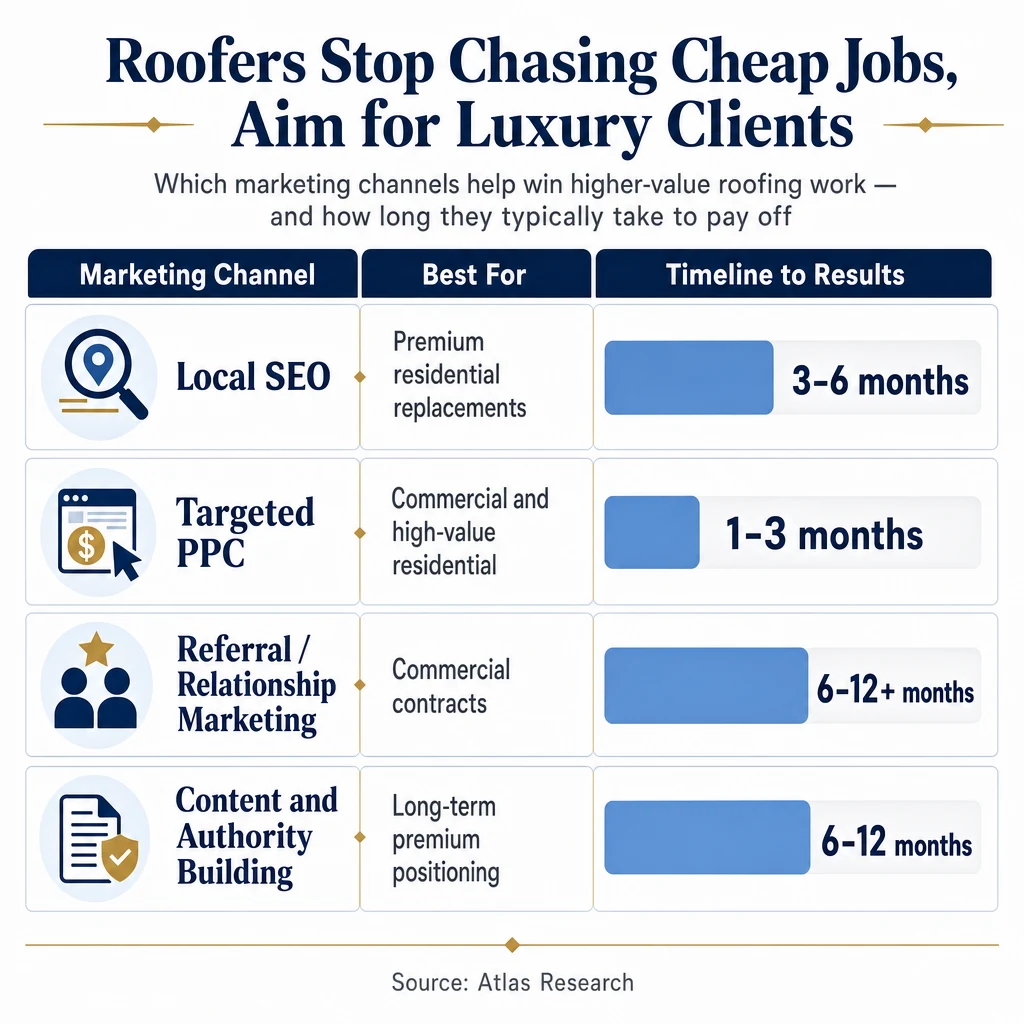
| Marketing Channel | Best For | Typical Timeline to Results |
|---|---|---|
| Local SEO | Premium residential replacements | 3-6 months |
| Targeted PPC | Commercial and high-value residential | 1-3 months |
| Referral/Relationship Marketing | Commercial contracts | 6-12+ months |
| Content and Authority Building | Long-term premium positioning | 6-12 months |
What This Means for hello.bz Readers
The shift from high-volume, low-quality leads to premium replacements and commercial contracts isn't just a marketing strategy it's a business model change. It requires you to think differently about who you're targeting, what channels you're using, how you're building proof, and how you're following up. It requires you to stop measuring success by lead count and start measuring it by revenue per crew, margin per job, and pipeline quality.
The good news: this approach doesn't require more marketing spend. It requires better targeting, better follow-up, and better planning. The contractors who are already winning premium work aren't necessarily spending more they're spending differently. They're investing in the channels and tactics that reach high-ticket buyers, and they're building the systems to convert those opportunities at higher rates.
Whether you're currently chasing volume and want to move upmarket, or you're already doing some premium work and want to systematize the approach, the practitioner's playbook starts with this question: what's your revenue goal, and what's the marketing architecture that gets you there?
Where to Read Further
For a deeper look at the marketing gap analysis approach that informs this high-ticket strategy, explore hello.bz's roofing marketing framework and their 12-month plan methodology built specifically around revenue goals. For additional tactical coverage, Brent Bird's 12 ways to effectively market your roofing business provides a comprehensive channel breakdown, while Thomas Harrison's roofing marketing ideas overview covers the foundational strategies that support any premium positioning effort.